
Myhappypet
Meta · Us vs. Them
Ad copy
BLACK FRIDAY SALE LIVE NOW
The guilt hit me hard when I realized my dog's bad breath had been warning me long before I paid attention. It happened on a random Tuesday night. Nothing dramatic. Nothing special. I was sitting on the couch scrolling on my phone when my dog jumped up beside me and yawned right in my face. The smell hit me like a wall. Sharp. Sour. Almost metallic. Not the usual dog breath. Something deeper. Something off. I remember physically pulling back and saying his name like he had done something wrong. And the look he gave me made me feel sick. He had no idea why I reacted that way. He just wanted to be close. That was the moment the guilt started. But it was not until much later that night that it truly hit me. He was lying on his bed, curled in his usual spot, and every now and then he would lick his lips or swallow hard. I wondered if his mouth was bothering him. I watched him for a while. Too long probably. Trying to decide if I was imagining things or if something was really happening. But then he shifted and let out a small whine. One of those quiet ones that barely make a sound but somehow feel louder than anything else in the room. That was my breaking point. I grabbed my laptop and started searching. It was almost 2 AM. I typed things like: "dog bad breath warning signs" "why does my dog's breath smell like this" "how serious is dog bad breath" "dog licking lips but nothing in mouth" I hated everything I read. Every search result talked about bacteria. Plaque. Hidden problems beneath the gumline. Things you cannot see until they are advanced. Things that start quietly. Slowly. Without obvious symptoms. Things that most owners miss because dogs hide discomfort instinctively. But the one thing that kept repeating was this: Bad breath is almost always the earliest sign. I sat there staring at the screen, feeling this heavy pressure in my chest, realizing that he had probably been trying to warn me for weeks. Maybe even months. And I had brushed it off as nothing. I thought it was normal. I thought it was just what dogs smell like. I thought dental treats and brushing once in a while was enough. I was wrong. The next day I booked a vet appointment because my anxiety would not let me wait. I needed answers. I needed someone to tell me what was happening. But the appointment was two weeks away. The earliest available. Two weeks. That night I started paying attention to every tiny sign I had been ignoring. How he hesitated before chewing certain treats. How he stopped playing tug of war as often. How he would chew on one side of his mouth. How he would paw at his face every now and then. How the area around his gums looked slightly red if I angled his lip just right. I could not believe how blind I had been. And the guilt only got worse when I tried brushing his teeth that night. He pulled his head away. He hated it. He struggled. And every time he resisted a part of me thought he was telling me it hurt. That brushing was making it worse. And I felt like I was failing him in every possible way. I kept searching for answers. For something that made sense. For something that explained why brushing and dental treats were not fixing anything. Why the smell kept coming back. Why plaque returned so fast even after scraping. That was when I stumbled across something I had never heard anyone talk about before. Not in dog groups. Not from friends. Not from my vet. Oral microbiome. I had never even considered that my dog had one. Or that it could be out of balance. Or that everything I had been doing to fix the smell was only treating the surface and never the root cause. The deeper I looked, the more things clicked. It explained why brushing alone was not enough. Why plaque kept returning. Why bad breath came back even after dental treats. Why he seemed uncomfortable even though nothing looked awful on the outside. It was not about removing bacteria. It was about balancing them. I remember sitting there with my laptop open, reading about how oral bacteria multiply when the natural balance is disrupted. How some bacteria cause plaque and tartar. How others create that terrible smell. How the imbalance spreads across the gums quietly and slowly. And how the real trouble starts long before you ever see yellow on the teeth. It made me want to cry. Because once I understood that, everything suddenly made sense. The treats. The brushing. The chews. All of them were surface solutions. They never solved the deeper issue. They never reached the root of the problem. They never restored what his mouth actually needed. And I realized my dog had been fighting this battle alone. Inside his mouth. Every day. With me thinking a treat could fix it. I felt horrible. The real turning point, though, was not a product. It was not a suggestion. It was not an ad. It was a moment. A simple moment where he climbed onto my lap, rested his head on my leg, and let out a long, slow exhale. That same smell. That same sharpness. But this time, instead of pulling away, I leaned in. I wanted to understand what was happening inside him. Not avoid it. Not ignore it. Not treat it like an inconvenience. I wanted to actually help him. And that was the night everything changed. Out of desperation more than confidence, I tried something new. Something that focused on the internal balance instead of the surface. Something that worked with his mouth instead of against it. Something that was gentle enough for seniors yet strong enough to support a real shift in bacteria. I was skeptical. Very skeptical. But I tried anyway because doing nothing felt worse. Within the first few days I noticed small changes. He licked his lips less. He seemed more comfortable chewing. His breath was still bad but slightly different. Not as sharp. Not as sour. A week later the smell had noticeably improved. Not perfect, but better. He seemed happier. Lighter. More himself. And when he yawned beside me on the couch again, I did not pull away. I watched his gums. The redness softened. His chewing became more balanced. His energy returned. His eyes looked brighter. He played more. He rested more easily. And for the first time in months, I felt relief. Not because everything was fixed, but because I finally understood what was happening. I finally knew the real problem. I finally had a way to help him that did not rely on guilt or guesswork. I still feel a pang in my chest when I think about how long he tried to warn me. How patient he was while I missed the signs. How quiet the suffering was. How easy it was to overlook something so important. But I remind myself of something now. Something I learned the hard way. Dogs cannot tell us when something is wrong. Their breath does. It is the only warning system they have. And once you understand that, you will never ignore it again. I am sharing this because I wish someone had said it to me sooner. I wish someone had told me what bad breath really means. I wish someone had explained how the oral microbiome affects everything. I wish someone had shown me the signs before I reached that 2 AM panic search. So if you are noticing the smell, the licking, the gum redness, the plaque returning, the hesitation to chew, please do not ignore it. It is not just aging. It is not just dog breath. It is a sign of something deeper happening inside. And once you understand the real reason behind it, everything changes. Not selling. Just sharing something that saved my dog from months of quiet discomfort.
Call to action: Order Now
Creative notes
Why it fits
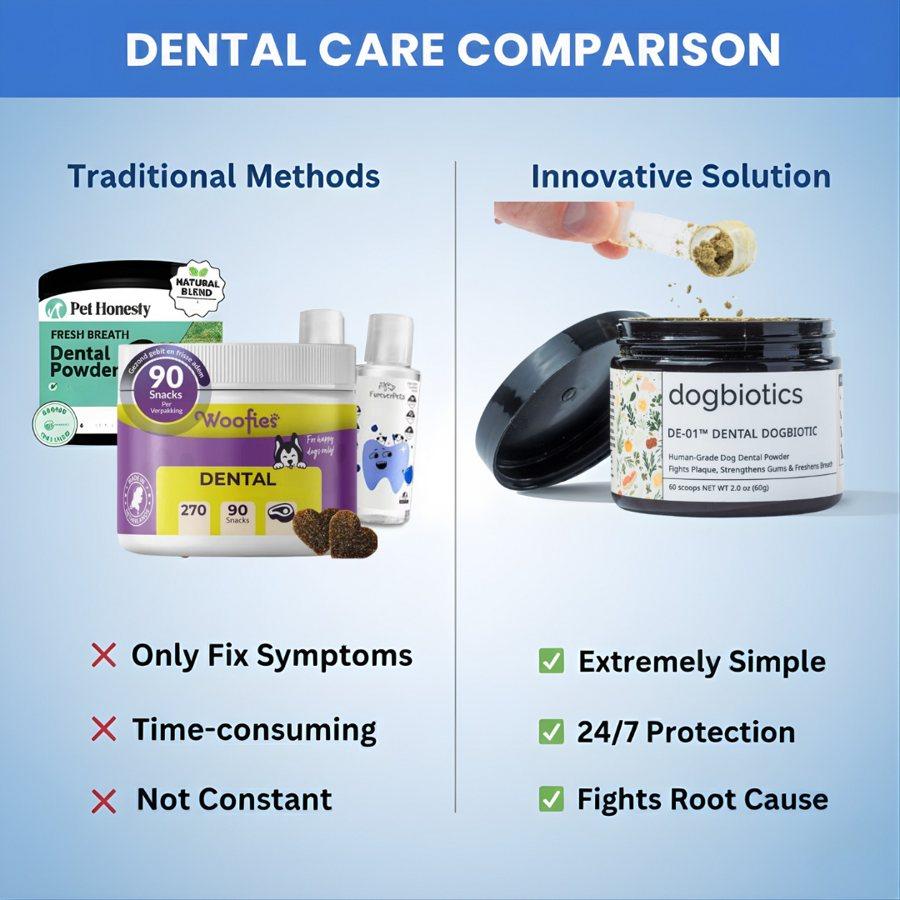
This composition is useful as a reference because it clearly contrasts traditional dental care products with an innovative solution, visually emphasizing the benefits of the latter. The side-by-side layout with product images and check/cross marks effectively communicates the comparative advantages and disadvantages, aiding quick consumer understanding.
Copy structure
Headline 'DENTAL CARE COMPARISON' → Left side product images and bullet points → Right side product image and bullet points
Elements to replace
headline; leftSideTitle; leftSideProductImages; leftSideBulletPoints; rightSideTitle; rightSideProductImage; rightSideBulletPoints
Adaptation guidance
To rebuild this mechanism with the customer's original assets, create a clear side-by-side comparison layout featuring the customer's traditional and innovative products. Use distinct icons or marks to highlight pros and cons, and include concise bullet points that focus on key differentiators without making unverified claims.
Ad details
Original creative belongs to Myhappypet. Recreate the idea with your own copy and imagery.