
Wang Support Group
Meta · Lifestyle Image
Ad copy
learninvesting.my
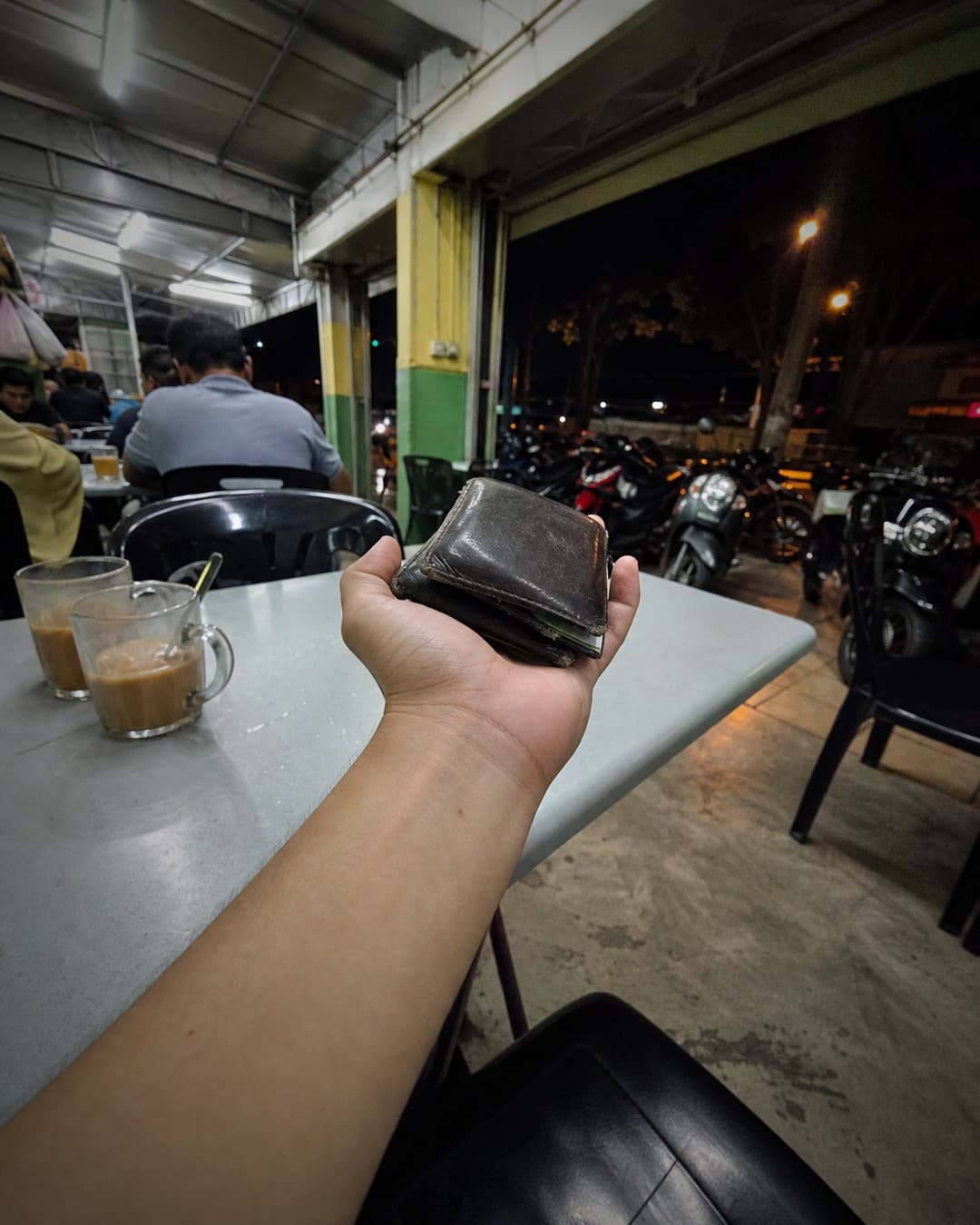
I found a wallet under a mamak table at 11:30 p.m. Inside was RM14, a faded company ID and a photograph from someone’s retirement dinner. When I returned it, the man who opened the door was wearing a delivery jacket. I almost left the wallet with the cashier. It was late. I’m 36, work as a production planner and had just finished another overtime shift. I wanted to go home. But when I opened the wallet to find a name, I saw the photograph. A man stood in the middle of a group of factory workers. There was a cake in front of him. A banner behind him read: “Thank You For 35 Years of Service.” Everyone was smiling. The man held a gold watch in one hand and a retirement plaque in the other. Behind the photograph was an old company card. Rahman Ismail Maintenance Supervisor I also found a handwritten card: “If found, please call my wife, Salmah.” I called. A frightened woman answered. Her husband had been retracing his delivery route for almost an hour. His driving licence, bank cards and the payment card he used for deliveries were all inside. Without them, he couldn’t work the next morning. She asked if I could leave the wallet at a nearby police station. The address on his MyKad was only 25 minutes away. I looked at the retirement photograph again. Then at the RM14 inside. “I’ll bring it,” I said. The house was a small terrace in an older part of Shah Alam. Neat, but tired. The porch light was on. A delivery motorcycle stood beside the gate with an insulated food bag strapped behind it. I knocked. A woman opened the door first. Before she could say anything, a man appeared behind her. He was still wearing a green delivery jacket. I held up the wallet. His entire face changed. He checked for his licence. Then his bank cards. Then he pulled out the retirement photograph. He stared at it for several seconds before placing it carefully back inside. His wife pressed both hands against her chest. “He has been searching everywhere,” she said. Mr Rahman thanked me repeatedly. Then Salmah insisted I come inside for tea. Normally, I would have declined. But the photograph looked almost identical to one from my father’s company dinner. Same cake. Same long-service plaque. Same smiling colleagues congratulating someone for finally reaching retirement. “I work in manufacturing too,” I said. “Just finished overtime.” Mr Rahman smiled. “I did enough overtime for three lifetimes.” That was what opened the conversation. The living room showed me who he had been before the delivery jacket. On one wall was the enlarged retirement photograph. Beside it hung the plaque recognising 35 years of service. There were photographs of Mr Rahman in a hard hat, standing beside machinery and surrounded by younger technicians. The gold retirement watch from the photograph was still on his wrist. On the floor beneath it sat his delivery helmet. A retirement plaque on the wall. A delivery bag by the door. Two completely different lives in the same room. Mr Rahman said he had only been making deliveries for a few months. “Retirement is boring,” he joked. “Better to stay active.” Salmah looked at him. Then she looked at me. “He tells people he drives because he is bored. He drives because every month without a salary frightens him.” Mr Rahman became quiet. Salmah began telling me about the man in the photographs. Mr Rahman started at the factory when he was 25. He arrived before almost everyone else. If a machine broke during the night shift, people called him. If a young technician made a mistake, he corrected it without humiliating them. He trained dozens of workers over 35 years. “He could repair anything,” Salmah said. Fans. Pipes. Motorcycles. Washing machines. He was the person everybody called when something stopped working. When Mr Rahman turned 58, his company held a retirement-planning briefing. The projection assumed they would spend approximately RM3,000 per month after the house was paid off. Based on that number, his EPF balance appeared sufficient. The presenter told him: “You’re on track.” Whenever Salmah worried about medical costs or helping their children, Mr Rahman repeated the same line. “The projection says we’re on track.” When he finally retired at 60, he had approximately RM480,000 in EPF. Their terrace house was fully paid. He had another RM35,000 in unit trusts. He didn’t gamble. He didn’t own an expensive car. He had never taken his family on luxury holidays. The factory held a large farewell dinner. His manager made a speech. His colleagues bought the watch. Everyone told him: “You’ve worked long enough. Now enjoy your retirement.” For the first year, it felt like freedom. No alarm clock. No traffic. No emergency calls from the factory. Then ordinary life continued. Groceries. Electricity. Insurance. Medication. Home repairs. Supporting an elderly relative. Helping their children during difficult months. Nothing extravagant. Nothing irresponsible. Their real household spending was closer to RM4,800 monthly—not the RM3,000 used in the projection. They used the RM35,000 in unit trusts during the first 18 months. After that, most expenses came from EPF. The dividends slowed the decline, but they didn’t replace the RM50,000-plus being withdrawn during expensive years. After the first year, Mr Rahman’s EPF had fallen to approximately RM445,000. By the third year, it was around RM350,000. By the fifth year, approximately RM250,000 remained. That was when Salmah began noticing the ritual. On the first Sunday of every month, Mr Rahman opened i-Akaun. He stared at the balance. Closed the app. Opened the calculator. Then sat quietly for the rest of the evening. “He stopped asking how much money we had,” Salmah said. “He started asking how many years we had left.” When the balance fell below RM200,000, Mr Rahman registered as a delivery rider. He was 66. Most evenings, he left after dinner and worked until midnight. On a good month, he earned between RM1,200 and RM1,800. Enough to slow the withdrawals. Not enough to stop them. The gold watch on his wrist was supposed to mark the end of his working life. Now he checked it between deliveries to see whether he had time for one more order. I looked at the retirement photograph again. The cake. The plaque. The smiling workers. Thirty-five years of service. And six years later, the man in the centre was riding through the rain carrying other people’s dinners. Mr Rahman wasn’t financially irresponsible. He had followed the plan most of us are given: Work hard. Contribute to EPF. Pay off the house. Invest whatever remains. Then retire. The plan had helped him accumulate money and assets. It had never shown him how those assets would replace his salary. I drove home in silence. When I opened the front door, my father was sitting at the kitchen table. An EPF statement was open in front of him. He was 58. Two years from retirement. He had worked for the same company for almost three decades. His EPF balance was approximately RM265,000. He had RM28,000 in FD. Another RM19,000 in unit trusts. Our family home was paid off. “How much do you expect to spend after you retire?” I asked. “Maybe RM4,000 a month.” “And how much income will come in after your salary stops?” He pointed at the statement. “I have EPF.” “That’s money you already have. What new income comes in every month?” He didn’t answer. I opened the calculator. Between EPF, FD and unit trusts, he had approximately RM312,000. At RM4,000 per month, that represented around six and a half years before inflation, medical costs or an emergency. “How long do you think it will last?” I asked. He looked uncomfortable. “Should be enough.” “How do you know?” “I’ve been contributing my whole life.” That wasn’t an answer. It was a belief. The same belief Mr Rahman had carried into retirement. That night, I couldn’t sleep. Every time I closed my eyes, I saw the retirement plaque on the wall and the delivery bag beneath it. I got out of bed and opened my laptop. My first search was: “How long will RM480,000 last in retirement?” The answers were useless. One article said it was enough. Another said Malaysians needed at least RM1 million. One calculator said 12 years. Another said seven. Everything changed depending on inflation, lifespan, healthcare and monthly spending. Then I searched: “What replaces your salary after retirement?” That search produced an entirely different kind of answer. I clicked past the videos promising 3% returns every day. Closed the pages filled with sports cars and screenshots. Ignored anyone asking me to transfer money before explaining what it was for. Then I found a recorded talk by a Malaysian investor. He wasn’t promoting one magical investment. He said property, stocks, businesses and other assets were only tools. The question wasn’t: “Which investment is best?” It was: “What job does your money need to perform next?” That question explained Mr Rahman’s situation better than any retirement calculator. His EPF wasn’t the villain. Neither was his house. Neither were his unit trusts. EPF helped him accumulate money. The house removed rent from his retirement expenses. The unit trusts provided another store of value. But none produced enough income to replace the salary that disappeared when he stopped working. He had spent 35 years filling a tank. Nobody had shown him how to build an engine that could refill it. That was the real problem. His job was the only engine creating new money. When the job stopped, the engine stopped. Everything else became a reservoir. Every month, the water level fell. Saving more could make the reservoir larger. It could not make it refill itself. The investor called this the One-Engine Wealth Trap. Then he explained the alternative. First, use suitable assets and opportunities to create and grow capital. Then move capital into assets designed to produce recurring cashflow. Grow capital. Convert capital into income. Reinvest. Repeat. Your job begins as the first engine. Over time, your assets become the second. The investor’s name was Dato Michael Tan. He had spent more than 20 years investing across property, stocks, businesses and other markets. He called his system Capital to Cashflow—or Capflow. I was still skeptical. A good explanation is not the same as proof. Then Michael showed the example of a Malaysian housewife named Melissa. Melissa joined his community in September 2023 because she was sick and tired of her financial situation. Her employment income was zero. According to her testimonial, she acquired two properties with no money down. Both were approximately 30% to 33% below market value. She expected rental returns of around 9%. The properties helped her obtain RM150,000 in cash-out capital. She then moved capital into another asset class. After two months in stock options, she separately reported returns approaching 5%. Across her developing portfolio, she also reported reaching approximately RM2,000 in monthly cashflow. Those results were not guaranteed. But the sequence demonstrated what Mr Rahman’s plan lacked. Melissa didn’t expect one asset to become her entire financial future. She used different assets for different jobs. I showed the recording to my father. At first, he became defensive. “I’m too old to start playing with investments.” I understood. He had two years until retirement. This was not the time to gamble his savings. So we attended Michael’s free training to understand the framework before making any decision. My father did not withdraw his entire EPF. He did not buy a random property. He did not hand his savings to a stranger. He reviewed what each part of his money was supposed to do. EPF remained part of his long-term reserve. The house remained our home. His emergency money stayed protected. After getting guidance and understanding the risks, he gradually repositioned RM60,000 from capital that had not been assigned a clear job. The first month, it produced approximately RM210. By the third month, the average was around RM380. By the sixth month, it was producing approximately RM540 monthly. That did not make him financially free. It did not replace his salary. But RM540 covered the electricity, water, internet and part of his insurance. For the first time, some of his monthly expenses were being paid without requiring another day of work. More importantly, he still had time. He was building the second engine before the first one stopped. The retirement photograph in Mr Rahman’s wallet no longer looked like proof that retirement had failed. It looked like a deadline. A reminder that the work must begin before the farewell dinner. That is why Dato Michael is holding a free live Capital-to-Cashflow training for working Malaysians. During the training, he explains: ✅ Why responsible saving can still leave you dependent on work ✅ How to distinguish capital-building assets from income-producing assets ✅ Why owning property, stocks or unit trusts is not automatically a retirement system ✅ How different assets can work together ✅ How accumulated capital can be moved toward recurring cashflow ✅ How to begin learning while employment income is still available This is not a get-rich-quick promise. It will not replace your salary next month. It does not guarantee Melissa’s results or the results in this dramatized example. Investing involves risk, and different people begin with different capital, knowledge and circumstances. The training is designed to explain the framework before you make major financial decisions. Click Learn More to register for the free live training. It wasn’t the RM14 inside Mr Rahman’s wallet that frightened me. It was the retirement photograph. He had worked for 35 years. Saved. Contributed to EPF. Paid off his home. Invested what he could. He had accumulated money. What he had never built was income capable of continuing after his salary stopped. My father still had two years. I had even longer. Time Mr Rahman no longer had. If you are still working, you have that same advantage. You can begin building the second engine before the first one stops. Click Learn More to reserve your place in the free Capital-to-Cashflow training.
Call to action: See details
Creative notes
Ad details
Original creative belongs to Wang Support Group. Recreate the idea with your own copy and imagery.